
PLAYBOOK · OCTOBER 23, 2026
A Water Main Broke Under Ring Road. A Worker Didn’t Come Up.
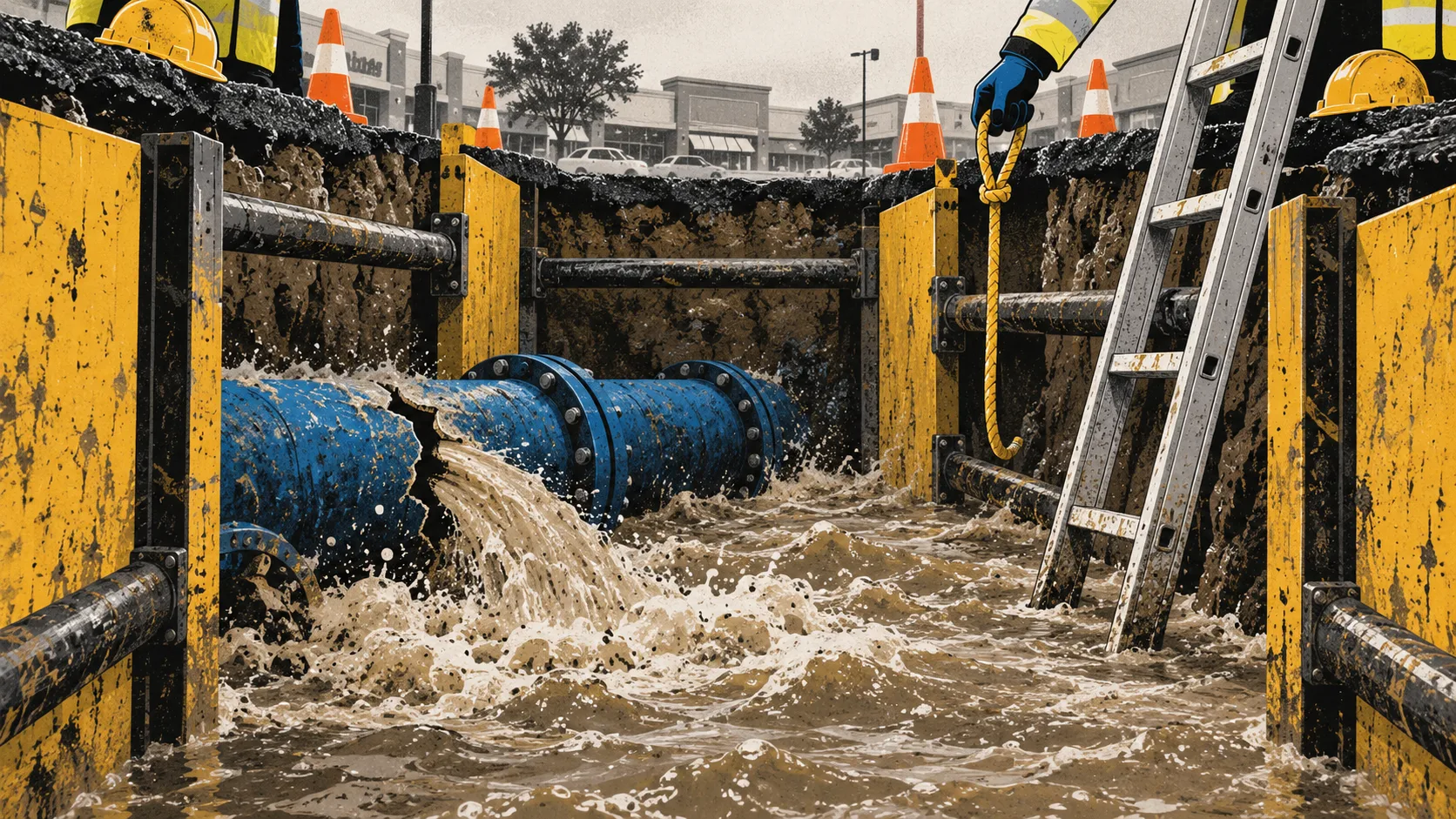
On Friday, October 9, 2026, around 11:13 a.m., a water main broke under Ring Road outside Roosevelt Field mall in East Garden City. Rafael Peralta, 56, was working underground when it went. The water came in over him.
His coworkers pulled him out. Responders worked on him at the scene. He was pronounced dead at the hospital.
He worked for a private contractor the mall hired to handle a private water main and hydrant on its property. Nassau County police are investigating. Nobody has said publicly why the main broke or how long he was under. We’re not going to guess. What we can do is talk about the hazard, because the same water mains run under every street in this city.
Water in a hole is not a puddle
A trench feels dry until it isn’t. A broken main doesn’t seep. It fills. You have seconds, and the walls you were standing between are now the reason you can’t move.
Everybody thinks of a cave-in when they think of a trench. Water kills the same way, faster, and it gets talked about less.
What the rule says
Federal OSHA’s excavation standard covers this directly.
- Water. 29 CFR 1926.651(h)(1): employees may not work in an excavation where water has accumulated or is accumulating unless adequate precautions protect them, such as special support or shield systems, water removal equipment, or safety harnesses and lifelines. Under 1926.651(h)(2), if water is being pumped out, a competent person monitors the removal.
- Utilities. 29 CFR 1926.651(b): the estimated location of underground utilities has to be determined before digging, and while the excavation is open those installations must be protected, supported or removed.
- A way out. 29 CFR 1926.651(c)(2): a trench 4 feet deep or more needs a ladder, stairway or ramp within 25 feet of lateral travel for every worker in it.
- Daily inspection. 29 CFR 1926.651(k)(1): a competent person inspects the excavation, the area around it and the protective systems daily, before work starts and as conditions change.
Source: OSHA 29 CFR 1926.651.
What that means when you’re the one in the hole
Before you climb down, ask three things. Where’s the water line, and is it live? Where’s my ladder? Who’s watching the top?
If nobody can answer the first one, you’re not being difficult by asking. You’re being the only person on site who read the standard. If the ladder is 60 feet away behind a pile of spoil, that’s not a ladder, that’s decoration.
And if water starts coming in, you get out. Not after you finish the joint. Not after you grab the tool. Out. The pipe will still be broken in five minutes. You might not be around to see it.
Why this matters in New York City
This happened in Nassau County, outside the city, and Long Island sites don’t require an SST card. But NYC sits on the same kind of buried infrastructure, and NYC DOB requires Site Safety Training for most workers on sites that need a site safety plan under Local Law 196 of 2017. Excavation and utility hazards are part of what that training is for.
The card isn’t the point. The point is knowing what to ask before you go down, and knowing you’re allowed to say no.
Next step
If you need your SST card, or you’re due to renew, start at sst.nyc/courses. The course is online, the card is processed immediately, and it’s typically in hand within 48 hours.
Our thoughts are with Rafael Peralta’s family and his crew.
Predictive Safety
Your SST card
Reading won't get you the card. The course will.
Pick your course, finish it, and get your NYC DOB SST card.
See the courses